Beyond the Averages: Why Consumer Credit Performance Demands Greater Visibility
A healthy portfolio doesn’t always tell the full story. As consumer credit performance becomes increasingly segmented, headline portfolio metrics can conceal emerging risks across borrower groups, credit tiers, and origination vintages. Our latest OMEGA Insights article explores why asset-level visibility, reliable data, and automated reporting are becoming increasingly important for securitization teams. At OMEGA Financial Systems, we're building technology to help teams move beyond portfolio averages, identify emerging trends, and connect collateral performance with reporting and compliance. Because the real question isn't just how your portfolio is performing. It's what's driving that performance.
September 22, 2026
•
10 minute read
As consumer credit performance diverges across borrower segments, securitization teams need to look beyond headline portfolio metrics to understand emerging risks.
The U.S. consumer credit market is telling two different stories.
At the macroeconomic level, consumers have demonstrated resilience. Yet beneath the headline figures, differences in credit performance across borrower segments reveal a more complicated picture.
For originators, investors, servicers, and securitization teams, this divergence raises an important question: Are traditional portfolio-level metrics providing enough visibility into emerging credit risks?
In September 2026, the Structured Finance Association (SFA) published research titled When the Small Tail Wags the Large Dog: Looking Beneath the Consumer Credit Headlines. The research highlights how broad economic indicators can conceal meaningful differences across borrowers and credit segments.
The implications extend beyond credit performance. They raise questions about how securitization teams collect, analyze, validate, and report the data underlying their transactions.
At OMEGA Financial Systems, we believe understanding these differences begins with better access to asset-level data and the infrastructure needed to turn that data into actionable insights.
1. The problem with portfolio averages
Portfolio averages provide an essential starting point for evaluating credit performance. Metrics such as delinquency rates, cumulative net losses, recovery rates, and outstanding balances help securitization teams assess the overall health of a transaction.
However, aggregate performance can conceal important changes within the underlying collateral.
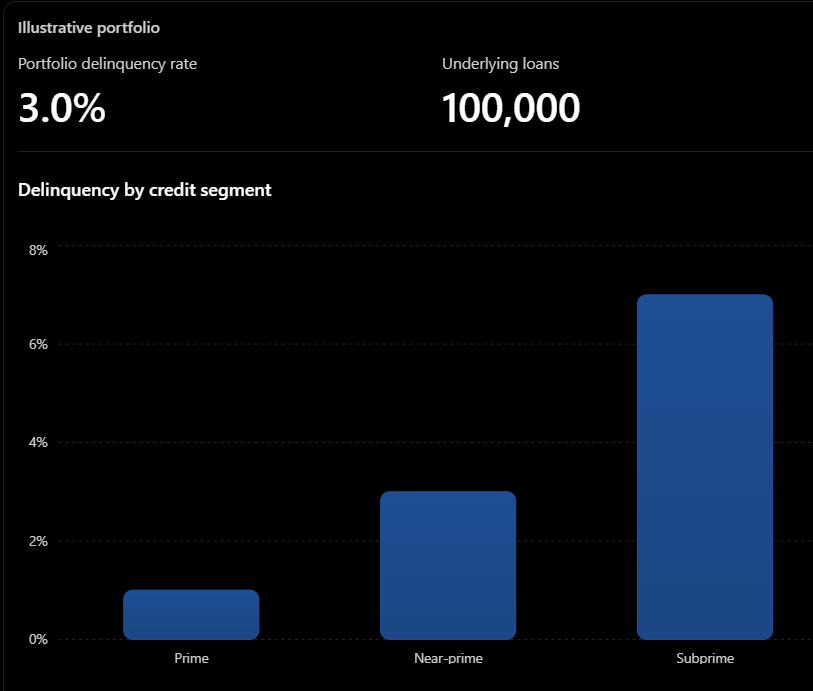
Consider a hypothetical consumer loan portfolio with an overall delinquency rate of 3%.
Hypothetical illustration, not observed market data. Assuming each segment represents an equal share of outstanding balances, the weighted average is approximately 3.7%.
The portfolio's overall performance might appear relatively stable even as deterioration accelerates within a smaller, higher-risk segment. Stronger performance elsewhere can offset that deterioration in the aggregate figures.
For securitization teams, this distinction matters because credit deterioration rarely affects every part of a portfolio equally.
Borrowers may respond differently to changing interest rates, inflation, employment conditions, and household expenses. Loans originated during different periods can also exhibit different repayment behavior, even when they belong to the same credit category.
A portfolio-level metric tells teams what is happening across the collateral pool. More granular analysis can help explain where those changes are occurring and which exposures deserve closer attention.
2. Why credit segmentation matters for securitization
The importance of credit segmentation becomes clearer when viewed through the structure of an asset-backed security.
A securitization pools financial assets and uses their cash flows to support payments to investors. The performance of the underlying loans influences the transaction's cash flow, credit enhancement, and ability to meet its contractual obligations.
When borrowers begin missing payments, the implications depend on more than the headline delinquency rate.
The location, concentration, severity, and persistence of those missed payments all matter.
For example, deterioration concentrated in loans originated during a particular quarter could indicate that underwriting conditions or borrower affordability differed during that period. Rising delinquencies across multiple vintages might suggest broader economic pressures.
Similarly, a relatively small concentration of higher-risk borrowers could contribute disproportionately to losses.
Historical research illustrates why these distinctions matter. In November 2025, SFA reported that prime auto ABS performance remained relatively stable while subprime performance deteriorated. Its analysis cited S&P data showing subprime annualized losses of 9.4% and 60-plus-day delinquencies of 6.8% in September 2025. Those figures describe a specific historical period and collateral segment, rather than the entire consumer-credit market today.
For securitization teams, the lesson is not that one segment always performs poorly. It is that different segments can respond differently to the same economic environment.
That makes the ability to move between aggregate portfolio performance and individual collateral characteristics increasingly valuable.
3. From monthly reporting to continuous portfolio visibility
Traditional securitization operations often revolve around recurring reporting cycles.
Asset-level data is received from servicing systems, validated, reconciled, processed through calculation models, and incorporated into monthly servicer reports and investor reporting packages.
These processes are essential. However, when data preparation and reporting rely heavily on manual workflows, analytical work can become secondary to producing the required outputs.
A team may have access to the information needed to identify emerging deterioration without having a convenient way to analyze it.
Consider a scenario in which a consumer loan portfolio experiences an increase in early-stage delinquencies.
The aggregate report might show a modest month-over-month change. To investigate further, analysts need to determine whether the increase is concentrated among recent originations, specific credit tiers, certain geographic regions, or loans with particular characteristics.
They may also need to distinguish between a temporary increase in missed payments and a sustained deterioration in repayment performance.
Answering those questions requires consistent data definitions, reliable historical records, and the ability to compare performance across multiple reporting periods.
From reporting to understanding
Identify the change
Detect a movement in delinquency, loss, recovery, or repayment metrics.
Locate the exposure
Break down the change by vintage, credit tier, geography, product, or other relevant characteristics.
Investigate the drivers
Compare current performance with historical patterns, servicing activity, and changes in portfolio composition.
Assess the transaction impact
Evaluate the potential implications for cash flows, concentration limits, covenant thresholds, and reporting.
These capabilities become particularly important as portfolios grow, deal structures become more complex, and reporting obligations expand.
The objective is not simply to produce more dashboards. It is to reduce the time between identifying a change in portfolio performance and understanding its potential implications.
4. Why data quality is just as important as analytics
More granular analytics are only useful when the underlying data is reliable.
In securitization, information often originates from multiple systems, including loan origination platforms, servicing systems, collateral databases, and financial reporting tools.
Differences in data formats, reporting conventions, field definitions, and calculation methodologies can introduce inconsistencies.
Even relatively simple metrics can become difficult to reconcile when different systems apply different definitions or reporting dates.
For example, a delinquency calculation may depend on whether balances are measured at the beginning or end of a reporting period, how days past due are determined, and which assets are included in the denominator.
If those definitions are not consistent, comparing performance across periods or transactions can produce misleading conclusions.
This creates a need for a connected data-management process that includes validation, normalization, reconciliation, and traceability.
A reliable reporting environment should allow teams to move from a portfolio-level metric back to the underlying assets and calculations supporting it.
When a delinquency rate changes, analysts should be able to identify which loans contributed to that change, how the metric was calculated, and whether the underlying data passed the necessary validation checks.
The question is no longer just what the number is. It is where the number came from and what is driving it.
5. How OMEGA is approaching the challenge
At OMEGA Financial Systems, we are developing OMEGA Securitization Manager to address the operational complexity behind securitization.
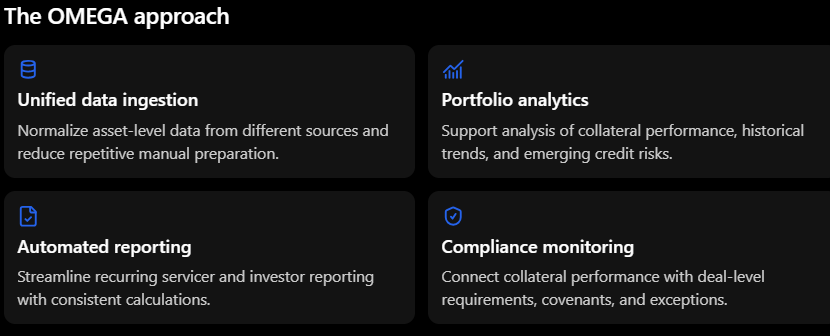
Our approach begins with connecting the processes that are often managed separately: data ingestion, deal management, reporting, compliance monitoring, and portfolio analytics.
Rather than treating reporting and analysis as independent activities, OMEGA is being designed to create a connected environment in which teams can work from consistent, validated information.
OMEGA's product direction. Capabilities are under development and may vary by implementation.
This integrated approach has implications beyond operational efficiency.
When reporting, compliance, and analytics share a consistent data foundation, teams can spend less time reconciling information between systems and more time investigating changes in portfolio performance.
For example, an analyst investigating rising delinquencies should ideally be able to examine the affected collateral, review historical performance, assess relevant covenant thresholds, and understand the implications for the next reporting cycle without repeatedly rebuilding the underlying dataset.
That is the type of connected workflow we are building toward.
6. The future of securitization requires more than reporting
As consumer credit performance becomes more differentiated, the ability to understand underlying collateral is increasingly important.
Portfolio averages will remain essential. But they should be the beginning of the analysis, not the end.
For originators, this means understanding how different borrower segments and origination vintages contribute to overall portfolio performance.
For investors, it means having the transparency needed to evaluate collateral quality and distinguish between transactions with different risk characteristics.
For treasury and securitization teams, it means connecting credit performance to funding decisions, transaction structures, reporting obligations, and compliance requirements.
Technology cannot eliminate credit risk or predict every change in borrower behavior. It can, however, help teams identify emerging trends, investigate exceptions, and make better use of the information already available to them.
The industry does not necessarily need more data. It needs better ways to connect, validate, interpret, and act on that data.
Conclusion: Look beyond the averages
The Structured Finance Association's September research highlights an important challenge for the securitization industry: headline consumer-credit indicators do not always capture the differences developing beneath the surface.
As those differences become more significant, the quality of portfolio surveillance depends increasingly on the infrastructure supporting it.
At OMEGA Financial Systems, our goal is to help securitization teams move beyond fragmented data and manual reporting toward a more connected, transparent, and analytical operating environment.
Because understanding a portfolio requires more than knowing its overall performance.
It requires understanding what's driving it.
SOURCE AND FURTHER READING
Structured Finance Association, September 2, 2026
When the Small Tail Wags the Large Dog: Looking Beneath the Consumer Credit Headlines
Editorial note: The portfolio example is illustrative. A portfolio composed of 50% prime, 25% near-prime, and 25% subprime balances at the illustrated delinquency rates would have a 3% weighted-average delinquency rate. The historical auto ABS figures are from 2025 and are not presented as September 2026 performance.
Want To Talk To The People Behind It?
The CEO Takes Every Call Personally.
45 minutes with William - no sales team, no deck you haven't asked for. Whether you're evaluating an investment or exploring the platform for your team.
.svg)